


From Afribol to AI: Bengyella Gwanmesia – ep. 5
A market treat became a supermarket order at Albert Heijn. A mother’s mission became the start of a language AI company. Bengyella Gwanmesia, founder of Batazia, tells us how one idea from his mother grew into a company making African languages digitally accessible.
Born in Britain, Cameroonian by blood, and Rotterdam by upbringing. That’s how Bengyella, who goes by Ben, likes to introduce himself: “That’s the holistic view of me.” After a bachelor’s in business administration and a master’s in finance, he went exploring, in his own words. Music, entrepreneurship, a bit of everything. Until his mother came up with an idea that changed everything.
From Afribol to Albert Heijn
Ben’s mother wanted to raise money for birth aid in Africa, for women who couldn’t afford it themselves. She came up with a food treat, the Afribol, and started selling it at markets and street fairs across the Netherlands. It was an instant hit. “As soon as people tasted it, it sold out,” Ben recalls.
Where his mother was happy with a successful market stall, Ben saw more. “I told her: if you want to make this big, you need to think big.” He picked up the phone and called the head offices of every supermarket chain in the Netherlands. The first to say yes was Albert Heijn.
When the order came in for two pallets, nobody on the team actually knew what that meant. “How many even go on a pallet?” Ben laughs. It turned out to be more than eleven thousand. “I had no idea what to say, we just went for it.”
Education in your own language
A few years later, his mother came up with a new idea, this time about education. She grew up learning in her own language, but on her first day of school, the textbooks were in English or French. According to UN research, Africa is the only continent where roughly half of all children start school in a language that’s foreign to them.
For Ben, who simply went to school in Dutch in the Netherlands, that was hard to imagine. “Why would you have to learn a new language before you can even get an education?” The idea took shape: use AI to translate schoolbooks into local languages, so children can learn in the language they already speak. That’s how Batazia was born.
Finding focus in a country of languages
Batazia builds language AI for African languages: text, speech, and everything in between. Companies and organizations that want to communicate across Africa can turn to Batazia for custom-built or localized AI models.
The first customers came through Ben’s network, mostly NGOs running education projects. Looking back, he’d do it differently. “It takes a long time to land a project with an NGO, and that’s tough for a startup that needs to move fast.” Still, that period brought valuable projects and market insight.
Batazia 3.0: the pivot
Batazia is now three years old and, as Ben puts it, on its third version. “What you think you’re going to build is often not what you end up with.” The company first built the engineering to create language models, but quickly discovered the real bottleneck: data. For many African languages, it simply doesn’t exist yet.
On top of that, Africa’s language ecosystem turned out to be fragmented. Different groups work on the same languages without knowing about each other, slowing digitalization down. Batazia is now building a central platform where everyone working on African languages can find each other and share data.
The dream: a continent that’s digitally fluent in its own languages
Ben’s goal is clear: he wants Africa’s digital future to run in African languages. In practice, that means translation models and speech technology for all 2,000-plus official languages on the continent, so every language stays digitally alive and every African can take part in the digital economy.
According to research Ben cites, around 90% of Africans don’t have full mastery of their country’s official language, whether that’s English, French, German, or Portuguese. “If I speak Dutch to you, you respond differently than if I speak French. The moment you communicate in someone’s heart language, everything changes.”
“Nobody has time to steal your idea”
Asked what he’d tell someone starting a company today, Ben doesn’t hesitate. Just start. “You don’t really understand what the textbooks are telling you until you actually do it.” Don’t be afraid to adjust your idea, as long as you hold on to the core of what you want to achieve. And maybe his most important tip: don’t keep your idea secret out of fear that someone will steal it.
“Nobody has time to steal your idea. It’s never about the idea, it’s about execution.” According to Ben, working well with people is the real challenge. “People management might be the hardest part of running a business.”
For Ben, what he’s building with Batazia doesn’t stop at Africa’s borders. He believes the model translates well to other language regions, from South America to Asia. “I’d love for others to copy this. Everyone deserves access to knowledge in their own language.”
When ambition meets reality is de podcast van Enbition waarin Tjitze Weststrate in gesprek gaat met ondernemers over hun ondernemersreis. We delen eerlijke verhalen van ondernemers die bouwen aan groei, structuur en impact. Geen gladde succesverhalen, maar gesprekken over wat er écht komt kijken bij ondernemerschap: keuzes maken, fouten herstellen, kansen pakken en blijven bewegen als ambitie de realiteit ontmoet.
Geen filters. Geen shortcuts. Gewoon het echte verhaal.
Abonneer je op ons YouTubekanaal en volg het echte verhaal.
Transcript – Bengyella Gwanmesia (Batazia)
Tjitze: Good morning. We are meeting again in the Nieuwe Kerk. Today I am meeting with Bengyella Gwanmesia from Batazia. It’s great to meet you and to get to know you a little bit. So maybe let’s just start: who are you, or how would you like to introduce yourself?
Ben: I’m glad to be here, thank you for having me. My name is Bengyella, but if you say Ben, I’ll still respond. I’m born British, but by blood Cameroonian, and by brain from Rotterdam. That’s the way I always introduce myself, because that’s the holistic view of me.
Tjitze: Great. And as we got to know each other, I grew up in Rotterdam too, so we felt a connection there, even in the same part of the city. Tell me a little bit about the thread in your career. How has that developed in your life?
Ben: I did my bachelor’s in business administration in Rotterdam, obviously, and my finance and investment master’s. When I got my paper, I went to my mom and my grandma and said, “Here’s my paper, now I’m going to go and explore.” So I went into entrepreneurship, but also did some music, just exploring what I enjoyed doing. Mostly I knew I wanted to be involved in business in some way.
The first thing that really launched my career came from an idea of my mother’s. She wanted to fund birth aid in Africa for women who couldn’t afford it themselves. In the Netherlands she didn’t have the money to pay for that herself, but she thought: people here are entrepreneurial and industrious, so let me find an industrious way to raise the money. She came up with a food treat and started selling it — what we call the Afribol. It was a huge success. Wherever she went, markets, braderieën, as soon as people tasted it, it sold out.
I saw what was happening and said, “Mom, if you want to do big things, you’ve got to think big. I’ll just call all the supermarkets in this country and see what happens.” Easier said than done, so I said my prayer [laughter], made a list of all the supermarkets with the numbers of their head offices, and started calling. Our first customer became Albert Heijn. Suddenly an idea from my mom, meant to do something good for others, became a business. That’s how I rolled into large-scale entrepreneurship.
Tjitze: That’s cool — spotting an opportunity and just trying to make it work.
Ben: Exactly. Even when we were chatting before, it was like: let’s just call Albert Heijn and see what they say, rather than starting small. Let’s just try — you shoot for the moon, and even if you miss, you still hit the moon.
Tjitze: And right now, what’s the company you’re working on, and how did that come to be?
Ben: That, again, was my mother’s idea. Growing up in Rotterdam, I hadn’t experienced certain specifics of African life myself, because I grew up in a Western environment. At some point my mom told me about something she was working on: using AI to make education and knowledge available in people’s local languages.
She explained that she went to school in her local language, but on the first day of school the books were in English or French. Even the UN says Africa is the only continent where about half the children start school in a language that’s foreign to them. For me, growing up speaking Dutch and interacting in Dutch, that was crazy — why would you first have to learn a new language before you can even become educated?
The idea became: use AI to create models that translate school books into local languages, so children can learn in their own language. That made complete sense to me, and I said I’d be happy to help. Knowing my entrepreneurial side, she asked me to get involved — and that’s how it actually started.
Tjitze: So again, there’s a need you saw, rooted in your own family history — and you immediately thought bigger than just a local problem.
Ben: Yes, sir.
Tjitze: So what’s the company called, and what do you do?
Ben: At some point my mother said, “I’ve started it, now you go run it.” That wasn’t necessarily the plan from day one, but once you’re in it, you get ideas, you see opportunities, and you see the impact you can make.
The company is called Batazia. Batazia is a language AI company focused on African languages — enabling organizations to run their content, communication, or digital services in local African languages, using either custom-built AI models or localized existing AI. Whether it’s text, speech, or reasoning, it’s all about making sure that if you’re focused on the African continent, you speak their language. That’s why we created the systems and workflows to make that happen.
Tjitze: Are your customers mainly African companies, or also international companies entering the African market?
Ben: That was one of our first major challenges, because language is at the bedrock of everything — of communication. There are so many use cases and so many ways to approach this, so finding that beachhead, that first area to focus on, was important. There’s a blessing in having so much space to cover, but you need to start somewhere, otherwise you spread yourself too thin.
For us, the initial group came mostly through our network — people who heard what we were doing. That first group turned out to be largely NGOs with big education projects within Africa, who had a real problem: they needed to localize their content. That seemed like a strong, in-demand place to start.
Tjitze: And was it a good place to start?
Ben: From a learning perspective, yes — the need is real. But it takes a long time before you actually land a project, and that’s not ideal for a starting company that needs to move quickly and stay agile. I wouldn’t start there again, though some great projects did come out of it. It steered us in a direction, but I’m not sure I’d put all my eggs in that basket again from the start.
Tjitze: Sometimes the market you think is the biggest need turns out to be the hardest to enter.
Ben: Exactly. Like I said earlier with the Albert Heijn story — I just went for it big. That worked out, with its own complications, but to me it’s about taking the direction where you can make the most impact.
Tjitze: When did you start with Batazia?
Ben: Three and a half years ago now.
Tjitze: Where are you now? What’s changed in your company’s direction as you’ve built it? Any moments where you thought, “we really need to pivot here”?
Ben: That’s a very relevant word — pivot. I’d say the current Batazia is Batazia 3.0, because what you think you’re going to start with is often not what you end up with. That’s a good thing, because you adjust as you gain market knowledge.
What we’ve really owned ourselves is the engineering side — creating language models when a new language is required. Say a Bible project needs a new translation in one of two thousand-plus languages, both Old and New Testament — if they want to use AI to speed up that process, we can build the models and the workflows to make that training loop happen. That’s our core.
But along the way we realized that the main thing that makes AI work is data, and the main thing not available for African languages is data. So we needed to solve the data problem. That led us to build smart workflows where we can generate data through usage and train better models, which is where we are now.
Another issue: the language ecosystem in Africa is very fragmented. People work in silos — one group works on a language here, another group works on the same language elsewhere, without knowing about each other. That means languages can’t digitalize quickly or well enough. So we’ve now created a central platform for Africa’s language AI, where you can go to one place, find the digital state of any language, and connect to the technology that’s already there. We want to create a unified ecosystem and move this whole space forward, faster and more efficiently.
Tjitze: So you’ve pivoted from being the company that does the work, to being the one gathering the data points and accelerating the whole ecosystem.
Ben: Yes — it’s really an infrastructure play. If you need to know what’s happening, or if you’re involved, come here, so we can all be visible to one another and collaborate. The data one person produces, another can use. It’s also a new space — the ground is still untouched, a blue ocean we need to help form. But we know the need is there, and I truly believe we’ll move forward faster if we come together.
Tjitze: In the West we don’t always realize how many people in African countries lack access to schooling, which means at an older age they still don’t have the education to build on. Language is a huge facilitator in changing that.
Ben: It’s everything. And it’s not just about the continent — it’s diaspora Africans, non-Africans, everyone working together. I’ve also noticed, when it comes to customers, that beyond the NGOs, there are multinationals wanting to enter Africa from outside. To penetrate those markets, you’d better speak the language. People assume Africa mostly speaks English or French, but you’d be surprised how many people don’t have a real mastery of those languages. You can’t communicate with people if they don’t fully understand you.
There’s research showing that around 90% of Africans don’t have mastery of the official language of their country — English, French, German in some countries, Portuguese. And Africa has over 2,000 languages. So it makes sense to communicate with people in their local language. If I speak Dutch to you, you respond differently than if I speak French to you.
Tjitze: [in Dutch] Je spreekt geen Frans, maar wel goed Nederlands.
Ben: Exactly — it’s a different way of communicating once you speak someone’s heart language. So it makes sense both for international companies entering Africa, and for the continental startups — the tech scene in Africa is crazy. Africa is leapfrogging, just like it skipped landlines and went straight to mobile. You’re seeing the same with AI — it enables real problem-solving, and locals know their own problems best. There’s a lot of tech talent, and they’re very keen on having their own languages supported so they can scale their own products.
Tjitze: What’s your vision of success for Batazia? When are you done?
Ben: In one sentence: when Africa’s digital future speaks its own languages, that’s when I’m happy. Practically, that means translation models covering all 2,000-plus official languages — and there are actually more than that. It means every language has speech support, text-to-speech and speech-to-text, and has been digitized — partly so the language itself doesn’t disappear, which is happening in many areas, and most of all so that every African, at whatever level, can connect and participate in the digital economy. Because once you can connect, so many more opportunities become available to you.
Tjitze: I love that phrase. What’s the one tip you’d give someone just starting their company today?
Ben: Start doing something immediately if you have an idea. Don’t wait, because you won’t really understand what the textbooks are telling you until you actually do it. I read books on operational management, psychology, and so on, and I didn’t really get what they meant until I went through it myself. The best way to learn business is by doing it.
Second: don’t be afraid to change your ideas. Know the core of what you want to achieve — that’s what matters. But don’t be afraid to see the way it manifests differently than you first imagined.
And last: if you’re going to work with people, make sure from the start that you really have a shared vision. Don’t just go along with it because you were friends beforehand — friendships can break under business pressure. Really check in with each other, ask the difficult questions early, and write things down so you have something to fall back on. People management is honestly the toughest part of it all.
Tjitze: I can relate to that — and I love the “don’t be afraid to change” part. People sometimes think so highly of their own idea that they forget execution matters far more.
Ben: Exactly. People are afraid someone will steal their idea, so they won’t tell anyone or won’t just run with it. But honestly — nobody has time to steal your idea. It’s not about the idea, it’s about execution. There are rare cases where you should stay quiet, if you have specific technology and someone else already has the infrastructure to immediately execute on it. But most of the time, that’s not the situation.
Tjitze: One question we always ask our guests: how easily could your concept be copied to other continents — China, South America, places with languages that also aren’t fully understood?
Ben: The way we’ve set it up, it’s very copy-pasteable, and I’d be glad if that happens. What we’re doing in the African languages space doesn’t exist anywhere else, and other language groups and families elsewhere could benefit from it. I feel like we’re creating a framework — I’d be happy to see it copied. We could do it ourselves too, but others should just go for it, because everyone deserves access to transformational knowledge in their own language.
Tjitze: What’s the one thing people watching this could do to help Batazia’s vision materialize?
Ben: I’d love everyone involved in the African language ecosystem to connect with us. We need everyone on deck — if you’re building datasets, building language models, or providing services that require localization, we want you involved. This is a movement, and we need to connect. Let’s all plug into the system, into the African continent’s language ecosystem that is Batazia, so we’re all visible and can collaborate.
Tjitze: We could talk for hours, but social media people will say it needs to be shorter [laughter]. It’s been so great meeting you, hearing your story — we’re going to hear a lot more from you, I’m sure.
Ben: Yes, sir. I’ve been following you a bit these past months, through Emmy, and seeing what you’re doing — I’m very excited to see how this plays out on the African continent. Thanks so much for the time.
Tjitze: Thank you. If people want to know more about Ben and Batazia, make sure to check out the website. What’s it called?
Ben: Batazia.ai — with a Z. Batazia, with a Z, dot ai.
Tjitze: Thanks so much for your time.
Ben: Thank you — it’s been a blessing, glad I could be here.
When ambition meets reality is de podcast van Enbition waarin Tjitze Weststrate in gesprek gaat met ondernemers over hun ondernemersreis. We delen eerlijke verhalen van ondernemers die bouwen aan groei, structuur en impact. Geen gladde succesverhalen, maar gesprekken over wat er écht komt kijken bij ondernemerschap: keuzes maken, fouten herstellen, kansen pakken en blijven bewegen als ambitie de realiteit ontmoet. Geen filters. Geen shortcuts. Gewoon het echte verhaal. Abonneer je op ons YouTubekanaal en volg het echte verhaal.


Chaos Pilots and Black Swans: Lars Peter Nissen – ep. 4
BECOMING A CHAOS PILOT: HOW LARS PETER TRAVELLED FROM WAR ZONES TO THE HAGUE’S TECH HUB
“I’d rather be a chaos pilot than a master of disaster,” Lars Peter Nissen says, laughing. “Master is quite pretentious.” Fifteen years as a crisis response manager in some of the world’s worst humanitarian settings taught him one thing: he thrives where things are messy. Now, from a tech hub in The Hague, he’s building ACAPS, an organisation trying to save the humanitarian sector from itself, and from AI.
Lars Peter was twenty when he left as a volunteer for El Salvador, sent by his father’s church to monitor human rights during a civil war. He wasn’t scared. “You think you’re immortal,” he says about it now. Only later did he realise how naive that was. “I’d never let my son go out the way I did.”
That trip marked the start of a career that, as he puts it, splits neatly into two halves. First, he was the person you send to an earthquake to bring order to the chaos, “a truck driver in disguise,” he jokes. Fifteen years ago he founded ACAPS: an organisation that analyses crises worldwide, so aid organisations know where to put their scarce resources to best use.
From host organisation to standing on its own feet
ACAPS started with five people, hosted by the Norwegian Refugee Council. A smart move: NRC had the offices, the systems, the scale, and ACAPS could piggyback on all of it. It worked well up to around forty staff. Then came growth to 140 people, right during Covid. “That’s a different beast,” as Tjitze neatly puts it.
NRC’s systems were built for large field operations, not for an organisation that mainly produces knowledge. Lars Peter and his team kept patching processes that no longer fit. Independence became inevitable, not just organisationally, but in substance too. If you’re critical of a government, you risk being expelled. ACAPS wanted to be able to speak freely, without forcing that choice onto its host organisation.
Why a cat food maker understands the sector
Becoming independent didn’t solve everything. Lars Peter is remarkably honest about a structural problem in his sector: who’s actually the customer? The people who need help, or the donors who pay for it? “A friend of mine says: really all you are is the cat food industry,” he says. “Cat food is not made for the cat. It’s made for the little old lady who owns the cat.” The packaging, the smell, the promise, all of it is designed to convince the owner, not the animal.
It’s an uncomfortable comparison for a sector that deals in human lives, and Lars Peter knows it. But he uses it deliberately: that gap between who you help and who pays you is exactly where things go wrong when it comes to accountability and effectiveness.
Coffee with the neighbours
That’s also why he chose not to base ACAPS at the Humanity Hub, where the rest of humanitarian The Hague sits, but at Hague Tech instead. “We don’t need to hang out with humanitarians. I’ve done that my whole career, and I’m very happy to drink beers with them at night. But during the day, I’d like to have a cup of coffee with somebody who works with blockchain, or synthetic data.” A deliberate choice to broaden his own ecosystem: different perspectives, different ways of thinking, different solutions.
What’s left when AI takes over the analysis
The conversation inevitably turns to AI, and Lars Peter makes no secret of his mixed feelings. “A lot of the work our analysts have been doing so far can be done by AI, almost as good,” he admits matter-of-factly. Still, he draws a hard line: the final editorial call stays with a human. He considers “human in the loop” a term that’s too vague, one that doesn’t really change anything about who’s accountable. At ACAPS, the principle is human in control.
For ACAPS, the analyst’s role is shifting towards what Lars Peter calls narrative stewardship: not just gathering data, but also helping decide how that data is used responsibly, in a world where, as he puts it, shared truth is becoming increasingly rare. Gaza, Ukraine, everywhere you look there’s a battle over the narrative, and AI makes producing disinformation nearly free.
That does worry him. “When you invent the ship, you also invent the shipwreck. And I’m not sure we know what the shipwreck looks like yet.” Especially because, in his view, AI models are poorly trained on the very people ACAPS is trying to help. Crisis victims simply aren’t a profitable group to collect data on.
No doomsday scenario, but a clear message
Asked about a doomsday scenario, crises converging into the perfect storm, Lars Peter calls the question itself “terrible.” Not because he shies away from the answer, but because crises, in his view, are black swans by definition: you expect a pandemic and get a tsunami instead. What he does know: doomsday doesn’t arrive for everyone at the same time. The most vulnerable are hit hardest, and first.
What keeps him grounded in that bleak outlook is what he sees in the people he works alongside in crisis zones. “The last thing you think is that these people are just victims,” he says. “They’re incredibly powerful, spunky, happy, suffering humans who teach you everything about life that’s worth fighting for.”
Don’t panic
Towards the end of the conversation, Tjitze asks for advice for a twenty year old who wants to change the world. Lars Peter’s answer is surprisingly simple: don’t panic. Where his own youth was a blank page, with no predefined path, a new generation is growing up feeling like they have to overperform, in a race where falling behind doesn’t seem like an option.
“If at 20 you had a plan for your life, you’d end up with a very boring life,” he says. His advice: wander around, fall down, and realise that stumbling is exactly where the learning begins.
When ambition meets reality is Enbition’s podcast, in which Tjitze Weststrate talks with entrepreneurs about their journey. We share honest stories from entrepreneurs building growth, structure and impact. No polished success stories, but conversations about what entrepreneurship really involves: making choices, fixing mistakes, seizing opportunities, and staying in motion when ambition meets reality.
No filters. No shortcuts. Just the real story.
Subscribe to our YouTube channel and follow the real story.
Podcasttranscript – Lars Peter (ACAPS)
Tjitze: Welcome, Lars Peter. It’s so good to have you. I was hoping that I could find you in a spot that you were in the Netherlands, and that I could get you into one of our podcasts.
Lars Peter: Fantastic. Great to be here.
Tjitze: Yes. And maybe the first question to start with is: okay, who is Lars Peter? How would you like to introduce yourself?
Lars Peter: Since we’re talking about work, I’d say, I don’t like to say I’m a humanitarian, I think that’s weird, but I worked in the humanitarian sector my entire career. So I’m probably a chaos pilot, that’s probably the best way to put it.
Tjitze: Chaos pilot. I like that.
Lars Peter: Some people would have the subtitle “master of disaster,” but you would call it chaos pilot. Yeah, I think it’s more honest. Master is quite pretentious.
Tjitze: Nice. And you say you’ve been working your whole life in the humanitarian sector. What does that look like?
Lars Peter: I started out as a volunteer in 1989. I went to work for a church in El Salvador, a politically very progressive church, as a peace guard. So we were basically human rights monitors, accompanying people who were under one kind of threat or another, to make sure they were safe. I was 20 at the time, and it was a very impactful experience, but it taught me that I really functioned quite well in messy situations. That was my main takeaway.
Tjitze: Wow. And because you didn’t grow up there, where did you grow up?
Lars Peter: I grew up in Denmark, in different parts, mainly the mainland.
Tjitze: And how did you get to go to El Salvador?
Lars Peter: My father is a pastor in the Lutheran church, and he was very involved in the ecumenical side of things, collaboration between different religions and church directions. He knew this church in El Salvador. And I had quite a wish to see the church really as a living part of the community. Being Danish and Lutheran, it’s quite cerebral, and not always as plugged into reality as you find in some places in the global south, and I wanted to experience that.
Tjitze: Wow.
Lars Peter: And I was, and I think I still am, quite driven by a desire for social justice, to try to make the world a slightly better place than it is now. That was also a strong motivation.
Tjitze: Yeah. That’s cool. I can imagine that has really shaped some of the choices you’ve made after those experiences.
Lars Peter: Yeah, and it shaped me in different ways. I felt like a massive failure, right? When you’re 20, you think you’re immortal, so the idea of being scared from being in the middle of a civil war never crossed my mind, stupidly. I’d never let my son go out the way I did. And secondly, you overestimate the impact you have on the world. So I felt like things that went wrong, that were totally out of my control, were my fault, and that was difficult to deal with.
Tjitze: Yeah. Right. And so we met, I think it’s three years ago now, probably two and a half, as you were working with ACAPS, which you’re doing right now, and looking into the next steps for that organization. Can you tell me, in short, you’ve worked in different humanitarian roles, what does that look like, and where are you now?
Lars Peter: Yeah. So I studied political science after my first experiences, and then quite quickly got involved in humanitarian action. If you look at my career, it breaks quite nicely into two parts. For the first half, I worked as what you would call a broad-spectrum humanitarian manager, right, the guy you send out to an earthquake to assess and coordinate a situation and get things off the ground. So quite operational, a truck driver in disguise, if you want. Really moving things, working in very difficult situations, trying to get things organized in a basic way. That’s where the chaos pilot part comes in. That was the first part. Then, about 15 years ago, I started something called ACAPS, which is basically business intelligence for the humanitarian community. We’re like a B2B function.
Tjitze: Yeah.
Lars Peter: Or an H2H function, as we actually call it, humanitarian to humanitarian. We try to enable humanitarian action by providing analysis of crises. We scan around 180 crises across the world and put together basic data around how they evolve, how big and how bad the crisis is. We also do forward-looking analysis, looking at what might be happening in the next six to nine months, for example.
Tjitze: Right. My assumption now is there must have been information but it wasn’t there, or was it just organized badly? What was the reason for you to think: we really need to start this?
Lars Peter: Two reasons, I’d say. One, it’s a quite specialized task, you need a critical mass of analysts. We are today around 100 staff in total. It’s hard for individual organizations to afford having that critical mass, to create that professional environment. You need to really dive deep into crisis. There’s like a handful of organizations like ACAPS that specialize in providing these services. And the second part is that we don’t do operations, right. We don’t actually hand out cash or blankets or anything, right, we just write reports. And that means we’re not systematically pulled in one direction or another. If you’re UNICEF or Save the Children, you have a natural, positive bias towards children.
Tjitze: Yeah.
Lars Peter: If you’re UNHCR, you will work with refugees, but you don’t have a mandate for internally displaced people, right. So how do you holistically analyze a situation, and how do you decide how to prioritize between food, water, health, education, right? That’s a really difficult choice to make, and we try to provide a holistic analysis that can help organizations negotiate that difficult equation.
Tjitze: Yeah, great. And I can imagine, ACAPS used to be part of NRC as an organization, that’s where you started it, or basically entrepreneured this new organization within the organization. How has that been for you? Because I came into the story when you tried to found ACAPS as a separate organization within the Netherlands. What is that storyline, how does that look like?
Lars Peter: Yeah, we started out, 15 years ago we were five people, it was quite small. We were hosted by the Norwegian Refugee Council, NRC, and that really worked well for us, right, because they had the whole setup. They had regional offices all over the globe, and we could piggyback on all of their capacity. They have maybe 12,000 employees, so it’s a massive corporate.
Tjitze: Yeah.
Lars Peter: And it was fantastic for us to be able to surf around inside that organization, and that enabled us to grow, and it worked perfectly until, say, 30 to 40 staff, we could still really handle it. But then as we grew and really scaled, and this was just about the time COVID happened, we grew quite quickly to 140 staff.
Tjitze: That’s a different beast.
Lars Peter: Yeah. And I would say two things happen. One, the systems that we operated on inside Norwegian Refugee Council were not designed for what we do. We do knowledge production, they do big field operations, it’s a very different risk profile, different staff, different everything. And so it became quite clunky, and we started developing all sorts of patches to the system to be able to report financially and whatever. And that’s not a stable situation to run on. It’s also hard to maintain the sort of entrepreneurial culture inside a corporate entity that is quite different in its rhythm and culture, and this is no criticism of NRC, it’s just two very different beasts.
Tjitze: Yeah. Right.
Lars Peter: And then finally, that independence I spoke about, where we’re able to see more holistically. There’s a second side to that: we don’t have an operational footprint, and so we can say things that are difficult for large organizations to say. If, for example, you really upset the government in Ethiopia, you may not work in Ethiopia much longer, right, you may be PNG’d, you get kicked out. And as our reputation grew, we didn’t want to create a risk for our hosts, and we wanted to be able to speak as clearly and freely as we could. That required us to be independent.
Tjitze: Yeah. And because I work in business mainly, yet at the same time I’m very much involved with, well, is it humanitarian or purposeful business, thinking how we can use business also for the good of a country or countries, or this world. And I think you’ve come from a humanitarian rather than a business background, yet you’re now in a business hub. You could have placed yourself anywhere, but you chose partly to be in a tech hub in the center of The Hague. What do you feel is there to gain for humanitarian or NGO organizations from the business world, and vice versa? What can we learn from one another?
Lars Peter: So I think there are different pieces to it, right? On one side we had the choice between going to the Humanity Hub and the tech hub, Hague Tech. We chose Hague Tech because we don’t need to hang out with humanitarians, I’ve done that my whole career, and I’m very happy to drink beers with them at night. But during the day, I’d like to have a cup of coffee with somebody who works with blockchain, or the food of the future, or synthetic data or something, right? It’s inspiring and it’s weird, and it is the skill set we need to understand as ACAPS to evolve and become the organization we need to be. So that’s the environment we’ve chosen to plunk ourselves into.
Tjitze: Yeah.
Lars Peter: Then there’s the business model, and that’s a bit more complicated. The humanitarian sector has quite a perverse incentive structure, in the sense that: who are our clients, if you want? Is it displaced populations, or the donors who give us the money? We sometimes call it upward accountability versus downward accountability. It’s not a way I really like to speak about it, but it’s a real challenge for us. I have a friend who says: really all you are is the cat food industry. And the reason he says that is that cat food is not made for the cat.
Tjitze: Yeah.
Lars Peter: It’s made for the little old lady who owns the cat.
Tjitze: Yeah.
Lars Peter: Right, and so the way it’s packaged, the smell, everything, is all there to convince the owner of the cat that the cat will be really happy with this. And it’s of course a very crude way of speaking about humanitarian situations where people are suffering. But it’s also a way of remembering that we don’t naturally have a way of being held accountable for whether we deliver good services for the people we serve. So that disconnect, between the people we serve and the people who give us the money, creates a really difficult situation, often around how you handle risk.
Tjitze: Yeah. Wow. And I can imagine that what you’re describing is placing yourself in an unusual situation on purpose, in a tech hub where there are so many different people, rather than saying “it’s not my ecosystem,” instead saying: no, if I place myself there, I will broaden my ecosystem, learn new things, look at the same situation from a different angle, and maybe get different, or better, results.
Lars Peter: Yeah, I think one of the big challenges we have as a humanitarian sector, and it hasn’t become easier over the past couple of years, is that we’ve seen quite a disruption of the consensus we have operated on. Exactly when I began my career, in 1989, when the Berlin Wall came down and the bipolar world disappeared, “end of history,” we’ve operated for decades with a consensus around humanitarian action that is eroding day by day as we speak.
Tjitze: Yeah.
Lars Peter: We now have the war in Ukraine, we have had the war in Gaza, we have the Middle East going on. And in all of those situations you can see a deterioration of the respect for international humanitarian law, for humanitarian actors, a lack of accountability, and that is fundamentally reshaping the way we can work. At the same time, about half of the resources we have for humanitarian action have disappeared, with the cut of US aid and the decrease in contribution from most of the major donors. So you can imagine operating in an industry where half the resources disappear overnight.
Tjitze: Yeah. Right.
Lars Peter: And so in that situation, the most important thing for people like us is that we remember that we are not the victims here.
Tjitze: Right. Yeah.
Lars Peter: It is actually the people affected by this crisis who are the most important actors, and we have to play offense no matter how much we’re cut down.
Tjitze: Yeah.
Lars Peter: And the way to play offense is to find a new humanitarian paradigm.
Tjitze: Yeah.
Lars Peter: And that’s basically what we’re trying to do. We’re trying to transform ourselves into a next-generation humanitarian actor, if you want.
Tjitze: Yeah, that’s really cool, because I can imagine, part of what you’re doing, and I think quite often people would make a separation between NGOs, and I’m probably myself guilty of this as well sometimes, thinking okay, we’ve got NGOs, they basically spend money, and then there’s businesses, and they make money. But part of that is actually rethinking: what is an NGO, what’s the product, who are we serving, what’s our client, and what’s the best way we can serve that need, and execute on that? What’s our value proposition, what’s the minimal viable product, how can you iterate on top of that product, how can you monetize it?
Lars Peter: We monitor risk, we provide data that is useful for a number of private sector actors as well, and we are exploring how we can begin to monetize some of that. As it is now, we put all of our analysis out free of charge. We’re like a public good in the humanitarian sector, and I think we should continue to do that for humanitarians. But why should big corporates not pay for the data they use? And they do use it.
Tjitze: Yeah. So basically thinking of how we can make sure that where there is value, there’s also paid-for value, and that it comes back into the business model you’re building.
Lars Peter: Absolutely. Yeah.
Tjitze: So what do you see for ACAPS in the next few years? I know you’ve been working on a roadmap towards what the future looks like as you’ve been establishing yourself here in The Hague. What are the big points on the skyline?
Lars Peter: Firstly, thank you for asking, because it’s difficult to actually remember that, because we chose to become independent in a situation where we at the same time lost half the money, and you have to build the new airplane while you’re flying the old one, and that’s expensive, and suddenly you only have half the money. So it’s been very challenging, and it’s very easy to get caught up in financial systems and pay scales and whatever else you have to do when you become an independent organization, and forget about the purpose. I think we have to rethink the way we work, because if you take aside everything else and just look at AI, and the way that reshapes our perception of what reality is, that alone requires us, we do knowledge production, we have to fundamentally rethink what our contribution is here. A lot of the work our analysts have been doing so far can be done by an AI, almost as good. You do need, we have decided that the final editorial control, or whatever we put out, lies in the hands of a human. Just talking about “human in the loop” is too weak, it really doesn’t shift any sort of accountability. But there’s no doubt that AI can reshape internally how we work, and we can save a couple of million dollars on that, in terms of staff time, and that staff time can then be put to other purposes.
At the same time, we also operate in a setting where the humanitarian narrative, the way we talk about humanitarian crisis, is being politicized, and become, or militarized, if you want. If you take in particular Ukraine and Gaza, you will see there are highly disputed versions of what’s actually going on.
Tjitze: Yeah.
Lars Peter: What is actually the situation in Gaza? Is it a genocide, or is it legitimate self-defense from Israel?
Tjitze: Yeah.
Lars Peter: What about Ukraine? You have seen massive disinformation from the Russians around what’s happening. You’ve seen the role of the Red Cross being disputed. So we are headed towards a situation where we talk about a loss of a shared truth.
Tjitze: Yeah. Right.
Lars Peter: So if we’re in a post-truth world, and if AI enables us to produce at the cost of zero dollars, how do we manage that? And so we are talking about a shift from being analyst to narrative stewardship. So basically thinking about how we can enable others to work with evidence in a safe manner, or in a more legitimate manner, right? Because the challenge is not necessarily going to be to do analysis, a lot of that can be done, but how do you steward the process of working with that? How do you shape that narrative? So we talk about narrative stewardship, and trying to figure out what does that look like for us.
Tjitze: Yeah. So rather than “human in the loop,” you say, no, it’s human in control. So actually, when it comes to what we publish as a company, what we publish to others, we want the human to be the responsible person.
Lars Peter: Whatever comes out must be the result of an editorial choice of a human.
Tjitze: Yeah.
Lars Peter: But how it’s used, and how it’s reshaped and reformatted with all the tools that are there, we can’t ignore that. So we have to get into that game, and create a platform where we can exercise narrative stewardship, and help actors come up with a principled humanitarian narrative. That’s really what this is about.
Tjitze: Yeah. I was speaking with a colleague this morning, from Cameroon, and I asked him, as we always ask our guests, do you have a question for the next podcast guest? And he said: thinking about all of this, and seeing all these things happen, is there a doomsday scenario lying around, given you have all these data points on these big crises? Is there an analysis model where you see, hey, wait a minute, now everything comes together and this basically becomes the perfect storm, or doomsday, however you call it, given some prediction six to nine months ahead? If so, what does that look like?
Lars Peter: That’s a terrible question. Well, it’s a good question, but it’s a terrible answer, I guess. If there’s one thing I’ve learned from working with crisis for a couple of decades, it is that they’re black swans. They are always what you think they’re not. So I don’t think we can predict the scenarios. We can point to some risks, right? I think massive population movements, as a result of climate change, or the wars we see, or the economic disruption we see, for example, in the Middle East, are very likely. Is that a doomsday scenario? If there’s one thing I know about the world, it’s that doomsday doesn’t arrive to everybody at the same time. Right. I think the most vulnerable are hit the hardest, and hit first, and that’s what we see now with Iran, for example, and the whole Middle East crisis. It’s a terrible situation for people in that region. The economic disruptions that we feel here in nice and cushy Netherlands, or even cushier Geneva, is nothing compared to what’s happening on the street in Pakistan or Somalia. And so whose doomsday are we talking about would probably be one thing I would say.
I am scared of AI. I think it’s an incredibly powerful technology, more than a hammer in our hands. And so when you invent the ship, you also invent the shipwreck, and I’m not sure we know what the shipwreck looks like yet.
Tjitze: Yeah.
Lars Peter: And I’m not sure the people developing this technology care particularly much for whether the ship goes down or not. And that really concerns me, especially because if you think about AI in relation to humanitarian action, it’s the worst possible use case. It’s low-frequency, high-impact events, affecting people you can’t make any money on. Nobody cares about the people affected by crisis, they fall through the cracks, and our job is to try to serve them the best we can. But it means that the models are not trained on data about them. And at the same time, you have bad actors who want to leverage this technology to mess up reality, and make victims look like terrorists.
Tjitze: Yeah. I think that’s a realistic, maybe not so happy, answer to that question. But I can understand there’s a real threat there, in all the data you see and what’s happening, plus this distorted reality that more and more comes to the forefront. And the question, for many of us, is: what can we still believe is true?
Lars Peter: Yeah. But I think the thing, whenever things go a bit dark, as what we’re talking about now, the thing that always brings it back for me, is that when you accompany people who are affected by crisis, you know that the last thing you tell them, or the last thing you think, is that these people are just victims.
Tjitze: Yeah.
Lars Peter: They’re incredibly powerful, spunky, happy, suffering humans, who teach you everything about life that’s worth fighting for. And it’s our bloody responsibility to do the best we can for them.
Tjitze: Yeah.
Lars Peter: And so we have to play offense, no matter how difficult it is, and we have to call out all of the nonsense that’s going on in the world right now, and just get with the program.
Tjitze: Yeah. Thank you, thank you, that is very powerful. One of the things I see right now, when I talk to younger people, and I’m considering myself a little bit older now because I do have some gray hairs, I see them quite often think about business, or starting businesses, with a very materialistic view of what business looks like, what it could bring them, and not so often yet do I see this humanitarian part of that thinking, actually, I could leverage this into really making an impact in the world. As a person, let’s assume there’s this 20-year-old guy from Denmark who thinks, I want to make a change in the world. What advice would you give him today?
Lars Peter: I’m trying to think about what that would be. I think I’d start by saying to him that you’re both incredibly lucky, and incredibly unlucky, because today, when I was 20, it was by and large a blank page, there was not a predefined biography for me. I could mess around and do weird things that I wanted to do, and not feel a massive pressure or danger of falling behind the race. And it really strikes me, when I look at my own kids, and just young people, my god, we’ve created a world where they have to super-perform and life is a race. So maybe: just don’t panic. I think that’s the first thing. Just don’t panic. And secondly, you’re also incredibly lucky, because we know so much more today than we did 30 or 35 years ago. You have opportunities, you have fantastic technology, you have knowledge, you have a schooling system that is significantly better than what I was messing around in. So you have opportunities, and then don’t panic, and find your way. And in finding that way, don’t feel like when you fall or stumble that you’ve lost, that’s where the learning begins, right? If at the age of 20 you had a plan for your life, you would end up with a very boring life.
Tjitze: Yeah. Right.
Lars Peter: You need to figure out what this thing is, so stumble around a bit. Don’t be afraid of the rat race. You’ll be okay. And go out and live some. Do it.
Tjitze: Yeah, I love that. My dad always said to me: “Jit, until you’re 40, it’s an internship. Just see it as a big internship, learn as much as you can.” Because those first 20 years, you’ll just learn, see, taste, experience things, and then you’ll find out, oh, actually, this is the thing I’m really good at. You don’t have to figure it out at 22, knowing, oh, this is my life goal. You know what, just see. And as you do that, you’ll find out, oh, that’s something I really love, or that’s the thing I feel really passionate about.
Lars Peter: Yeah. My dad used to just shake his head. He still does sometimes.
Tjitze: Well, luckily my dad shakes his head too, but that’s usually when I make a dumb comment. Anyway, thanks so much, Lars Peter, for your time. I think we could go on for hours talking about these subjects, and we definitely will do that at some point, but like you said, there are enough humanitarians to drink beers with in the evenings, as we can do here in The Hague. So thanks so much for your time and your attention, I’ll see and speak soon.
Lars Peter: Thank you for having me.
Tjitze: You’re welcome.
When ambition meets reality is de podcast van Enbition waarin Tjitze Weststrate in gesprek gaat met ondernemers over hun ondernemersreis. We delen eerlijke verhalen van ondernemers die bouwen aan groei, structuur en impact. Geen gladde succesverhalen, maar gesprekken over wat er écht komt kijken bij ondernemerschap: keuzes maken, fouten herstellen, kansen pakken en blijven bewegen als ambitie de realiteit ontmoet. Geen filters. Geen shortcuts. Gewoon het echte verhaal. Abonneer je op ons YouTubekanaal en volg het echte verhaal.

Still waters run effectively: how Vibrotwist is silently changing the offshore world
“They call this the valley of death,” says Stas Verichev matter-of-factly about the phase his company Vibrotwist is currently in. The term describes the notorious period between innovation and commercialisation, where tech start-ups can run aground. But this Russian-Dutch entrepreneur has already weathered quite a few storms. From missing out on investors to catching the “last grant train” at the last minute. Stas navigates challenges with the determination of someone who knows he has a revolution on his hands.
Eureka on the Maasvlakte
The story of Vibrotwist began six years ago with a moment of pure amazement. During a demonstration on the Maasvlakte, Stas saw a test pile go silently into the ground. “It was very noisy, and everything was shaking,” he says of the traditional method, “and then they switched to our method, and you couldn’t feel a thing… the pile just went in. I immediately thought, Wow, this is going to change everything!”
He can explain this revolutionary technology in surprisingly simple terms: “Imagine you’re on the beach and you want to put up your parasol. You don’t just push it, you twist it into the sand. That’s basically the whole idea.” By twisting piles instead of hammering them, Vibrotwist eliminates the deafening underwater noise and thus saves millions in noise abatement measures. This also significantly reduces installation time and makes it possible to completely remove the steel from the seabed later on.
From PhD to parasol pioneer
Stas’ path to entrepreneurship was not a straight line. “I started off as a researcher, then became an engineer, and then an entrepreneur,” he outlines his professional development. After completing his PhD at Delft University of Technology and prior working at Schlumberger, Royal IHC and Allseas, respectively, he ran a concrete mixer truck company in Russia. “I do have some entrepreneurial background,” he says modestly. That experience came in handy when he decided to commercialise his former supervisor’s revolutionary pile-driving technology.
Support where needed
Once Vibrotwist was established, the reality of running a business came into play. For a start-up, it is very important to fully account for grants and to have clear financial reports in order to convince investors. Through Delft Enterprises at TU Delft, Stas came into contact with Enbition and found them to be the right partner to support him in this. “They also help me with practical questions about matters such as taxes, which is nice when Dutch is not your mother tongue,” says Stas.

Welcome to the valley of death
Tech entrepreneurship comes with considerable challenges: “The biggest challenge remains financing,” says Stas. He hoped to raise money through a grant, but that also required a 20% personal contribution: “But my pockets were empty, and they wouldn’t accept my Albert Heijn bonus card,” he jokes. It became a race against the clock: “You’re trying to catch a train that’s already leaving the platform.” Fortunately, he managed to arrange a cooperation deal with Ampelmann and, with their help, to secure the last available HER+ subsidy before the programme was discontinued.
Now, two years later, the grant is coming to an end, and there is still no final deal with a commercial investor. Vibrotwist finds itself in what Stas calls “Valley of Death”: the period when money is running out, but the commercial breakthrough is yet to come.
“The offshore market is quite difficult, quite conservative,” he sighs. Soon, together with Ampelmann, will be able to prove their technology at sea. Only then will customers dare to get involved commercially. “And then it may take another five years before the first projects are actually up and running,” explains Stas.
Persevering despite uncertainty
Stas cannot yet say what the future holds: “In the worst case, Vibrotwist may go into hibernation. Like a bear in winter. But we will do our best to secure additional financial streams before that.” Despite all the uncertainty, his story is full of enthusiasm, and you cannot help but be convinced that their silent technology will save the industry billions and ensure that the construction of wind farms no longer causes nuisance to marine life.

Small, sharp, effective: how Flocsam is changing the consultancy game
“Most of my life has been pure luck, if I’m entirely honest,” Tom Fleuriot says with refreshing candor. But behind that modesty lies a sharp mind determined to shake up the consultancy world. From the charming Dutch town of Edam, he runs Flocsam, a company that supports companies’ legal teams without binding them to costly contracts. We spoke with Tom about his ambitions.
Tom’s story begins at defence and security company Babcock, where he worked on tenders, contracts, costs, pricing and compliance for submarine and surface ship fleets around the world. As well as offering him the chance to study law, his career progression led him to Australia. There he met his Dutch wife, with whom he eventually settled in Edam. He became Global Legal Director at Reckitt Benckiser, where he spent ten years supporting R&D, marketing, procurement, ecommerce and product development teams around the globe. This experience gave him valuable insights into how legal teams function in large corporations.
The Consultancy Circus
During those corporate years, Tom observed a frustrating pattern: consultancy projects often started small but grew into expensive, multi-year trajectories that frequently stalled or failed to deliver promised value. The biggest frustration? “All of the knowledge and understanding is housed in the consultant. I saw consultants doing this to us as a company.”
Small, Sharp, Effective
A year and a half ago, Tom decided to take the leap and launch Flocsam to approach things in a radically different way: “What I focus on in Flocsam is the smallest impactful change that you can make. We go very tiny, very narrow, very deep, and we produce a shift in working within two days.”
His process is clear: he visits the company, speaks with stakeholders, and determines within days what can change tomorrow and how success will be measured. As Tom sees it: “It’s like learning to fish. Give a man a fish and he’ll eat for a day, teach him to fish and he’ll eat for life. Probably you still can’t learn to fish in a day. It takes time and practice, but you have to start somewhere.”. If something can’t be fixed within two to three days, Tom believes that shows it’s too complex for the next step, and risks running into yet another failing long-term project: “Focus on what can be done”.
Tom Fleuriot, founder of Flocsam
A world of difference
As an international entrepreneur in the Netherlands, Tom faced practical challenges, for example with his previous accountant. As he puts it: “They showed no interest in what I actually did as a company.” A filing mistake eventually cost him a significant five-figure rebate.
Through Portside Tax, Tom was referred to Enbition, and he describes the difference: “When we had the kickoff session, their enthusiasm for seeing how you can maximize the financial assessment was brilliant. It was a complete sea change from the previous accountant.”
Now Tom works with Gabriella at Enbition and particularly values their shared philosophy: “It’s the exact same principle. You want people to have enough knowledge that they can have ownership and that they can do it themselves if they want to. While also understanding that sometimes it is more effective if someone with that day-to-day regular expertise comes in and does it for you.”
For Tom, the partnership provides peace of mind: “It’s just the comfort that I’m not getting it wrong, particularly as a non-native Dutch speaker. It means I have to spend less time second-guessing and looking into stuff.”
Let’s move fast, let’s fix something
Tom remains committed to his approach going forward. He already has several lawyers in mind to bring on board to make legal support “sharper, more outcome oriented and more systemic.” Even with growth, he sticks to his core principle: “I am deliberately rejecting the land and expand business model where you take a client, and you rinse as much cash from them as possible.”
For companies struggling with their legal workload, Tom offers a 60-minute conversation: “They download on me what their challenges are, and then I come back and say, look, here’s what I think will be that smallest impactful change. And then it’s like: let’s move fast, let’s fix something!”

Rapid Growth with Your Start-Up: This Is How PATS Does It!
Imagine this: a small drone that swats that annoying mosquito, so you can sleep undisturbed. In 2017, Bram, Kevin, and Sjoerd also found this a pretty bizarre idea, but they decided to explore what might be possible. This was the beginning of PATS Indoor Drone Solutions. After extensive research, it turned out that the real match for their technology wasn’t in the bedroom, but in horticulture. In early 2018, the idea was further developed, and in 2020, PATS welcomed their first customer.
The Start of the Start-Up
From a start-up with three founders, PATS has grown to over 14 employees in six years. How do you achieve such rapid growth? Bram Tijmons, CEO and co-founder, gives us a behind-the-scenes look.
“Developing technology takes time and money,” Bram explains. “Especially when you don’t have paying customers yet. That’s why we made use of programs like the NWO Take-off program and the UNIIQ investment fund.” In PATS’ early years, they carried out several (paid) pilots, allowing them to demonstrate interest in their technology and that there was a market for their solution. These pilots not only provided PATS with the necessary funding but also the confidence that they were on the right path. “We saw an opportunity to make a sustainable impact with our technology in the transition from chemical to biological pest control.”
The Challenge of Financial Administration
PATS started using Exact for their financial administration. “At first, I thought, ‘I can easily keep track of this myself. It’s straightforward, and I have everything under control.’ But as we grew, it quickly became more complex and took up more and more time,” says Bram.
A valuable tip led Bram to Enbition, and he quickly decided to outsource the financial administration. “Enbition not only took work off our hands but also brought structure and insights. Thanks to them, we were able to get a detailed view of our cost flows and justify our business operations.”
Continuous Innovation and Scaling
As a tech company, innovation is at the core of PATS. While scaling up, they continue to work intensively on developing their technology. “For example, we received the EIC Accelerator, a European subsidy that helps us continue our innovation,” says Bram. “To qualify for such subsidies and properly account for them, transparency and well-organized financial administration are absolutely essential.”
Bram Tijmons, CEO van PATS
The Role of Enbition
“Enbition plays a crucial role in accounting for subsidies and maintaining an organized administration,” Bram continues. “Thanks to Bart from Enbition, we can view our finances in detail with just the push of a button. He has streamlined everything. I don’t know if he ever takes a vacation because he seems to always be available. I can call or text him anytime for advice. His hands-on approach and extensive knowledge are incredibly valuable. It’s fantastic to have such a personal collaboration!
Tip
Bram is now focused on attracting new financing and closely monitors PATS’ recurring revenue. “Looking back, there is one thing I would definitely have done differently,” Bram reflects. “I would have started working with Enbition much earlier. It has given us so much insight and peace of mind. My advice to other start-ups? As soon as you notice you’re spending more than a few hours a week on invoicing and other administrative tasks, seriously consider outsourcing them. This allows you to focus on the growth and core activities of your business, and gives you a clear view of your financial position.”

Dashboarding: How do I present my company to interested parties?
If you run a startup and have ambitions to grow, it is instrumental to be able to convince investors of your potential. An important part of this is having a well-organized dashboard. And no, it doesn’t have to be an expensive system! In this blog, Tjitze explains why dashboarding is so important and how you can use it to effectively present yourself to financial parties.
What is Dashboarding?
Dashboarding is the process of collecting, visualizing, and interpreting key data in a clear overview – a dashboard. This allows you to quickly gain insights into your company’s performance and support strategic decisions.
Tjitze explains: “When presenting to an investor, you need to not only pitch your idea and solution but also make it clear how you’re going to make money with it. Investors want to know that you have a firm grip on your finances and that you understand precisely what’s important for your success.”
The first question when setting up a dashboard is: what exactly do I want to know?
Tjitze emphasizes the importance of setting specific goals from the start. If my company is successful: what does that look like? A good dashboard provides insights into both financial and non-financial goals. Tjitze explains: “Often people remain vague in their approach: ’Just measure as many things as possible,’ or they think ‘we’ll report on costs and profits.’ But if you don’t focus on specific goals, you won’t achieve your success. That profit should be the result of achieving your objectives.”
Choose a fancy system
Set up a dashboard with your specific goals and make sure to regularly review it. ‘How are we performing compared to our objectives?’. A dashboard doesn’t have to be a fancy tool – an Excel spreadsheet can work perfectly, as long as it helps you monitor and evaluate your goals clearly.
Stay Focused!
“It’s about having clear goals,” says Tjitze. “Whether you pull that data from Excel or a nice PDF, investors can see through the fancy presentation. The most important thing is that you can demonstrate that you know where you’re heading and can objectively determine if you’re achieving your goals.”
Tjitze encourages using the OKR method (Objectives and Key Results). This method helps in setting the most important goals for your company and linking measurable short-term goals to them that will help you achieve success.
Measure, Evaluate, and Plan
Once your goals are set and measurable, it’s important to evaluate regularly. “Schedule a review, whether it’s weekly, monthly, or biannually – find what fits your business. Then ask yourself: do you think you’ll achieve your goals? If the answer is yes, great, keep going. If the answer is no, it becomes a discussion point: what will we do to still reach the goal? This ensures you constantly confirm you’re on the path to success.”
A Helping Hand
If you’re struggling to get concrete goals on paper or if your team can’t agree internally, Tjitze assists companies – whether starting or already established – with setting up dashboards through business consultancy that goes beyond financial figures. In one or more sessions, he asks critical questions and helps clarify objectives. “It’s best if an internal employee takes over the process and handles the monitoring,” says Tjitze. “Sometimes I stay involved to keep asking the critical questions and ensure the company stays on track.”
Want to know more about how Enbition can help your company with dashboarding and project management? Get in touch with Tjitze!

Populytics: from rapid growth to calm and clarity through project control
Achieving the company’s five-year goals in just eight months is an impressive feat. This is exactly what Populytics has accomplished. However, this also raises the question: how do you maintain control over your projects during such rapid growth? This blog delves deeper into Populytics’ successful approach and offers insights for other service-oriented companies.
Populytics: innovation and participation
Populytics emerged from academic research and has not slowed down since. The company applies an innovative methodology to better involve citizens in government decision-making. Through the use of Participatory Value Evaluation (PVE), citizens can digitally take the place of ministers, politicians, and other decision-makers. They engage with an issue and advise decision-makers, ensuring citizens are effectively involved in government decisions. Shira Hollanders, director of Populytics, explains: “Our goal is to truly make the voice of the citizen count. With our methodology, we can present complex decisions in an understandable way and make meaningful participation possible.”

Calmer waters
Since its founding at the end of 2020, Populytics has grown rapidly. “After five months, I fully committed and became a co-owner of the company, and we now have 14 employees, 12 of whom are in the research team,” Shira says. “Our clients are mainly ministries, provinces, and municipalities. We are now in calmer waters, which is what we wanted. We no longer need to move at the same frantic pace as the past years.”
In addition to government agencies, Populytics is now also targeting the business sector as a new market to involve employees in decisions that affect them. “We remain ambitious,” Shira adds.
From little insight to calm and clarity
At the start of their journey, Shira and her team had little insight into their finances and were dealing with a labor-intensive bookkeeping process. This changed quickly when they were introduced to Enbition in the spring of 2021. “Tjitze from Enbition helped us largely automate our bookkeeping and brought structure to our financial planning and project management. That brought us a lot of peace,” Shira says. Tjitze from Enbition adds: “Starting a business out of passion is fantastic, but in the long term, it’s necessary to have good control over your projects. This helps you manage costs, monitor results, maintain satisfied customers and employees, and, above all, ensure profitability!”

Project Control
How do you, as a consultancy company, maintain control over your projects? Tjitze offers three tips:
- Monitor projects from the lead phase. Your first conversation with a lead is the start of the project. How big is the deal? How much time can you spend on it? Does the client have a budget? Also, include the financial goals of a project from the start so you’re not surprised later.
- Make one person responsible for the project. This person should report on everything, including finances. This is what we call project control. Even if this person doesn’t execute all tasks, they maintain an overall view.
- Set clear goals for margins and results. How much margin do you want on a project? Do you always aim for 10% or 30%? Clear goals are essential for effective project management—make them measurable.
Sharing goals
A crucial element in aligning your entire organization is making your goals clear within the company. Tjitze explains: “Populytics has done this well by applying the Objectives and Key Results (OKR) methodology, setting goals, measuring and tracking them regularly. They also share their goals with the entire organization, so everyone is aware and involved in working toward the common goal.”
Enbition tailors its approach to you
“Enbition is an accessible and pragmatic organization,” Shira says. “They consider the stage your company is in and adjust their approach accordingly. They are flexible in their thinking, which is great.”
Want to experience what Enbition can do for you in terms of project control? Contact Tjitze!

"What I think would be really cool is to work on all the transformer houses in the Netherlands with our product."
Respyre is turning cities green using their bio-receptive concrete that moss can thrive on. We spoke with their founder and CEO, Mark de Kruijff, who we've been working with since last year. We hope in this interview we can learn more about the exciting world of moss.
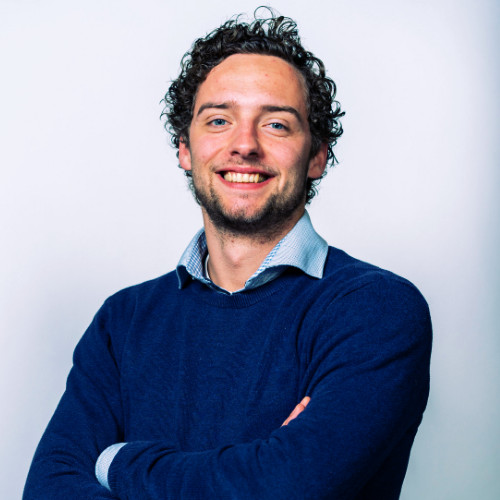
Hi Mark! It's great to get to sit down together and catch up. Let's go back to the beginning of your ambitions. How did you get started with Respyre?
After my master's in physics, I started at Delft Enterprises, the valorization center of TU Delft. At the center, we looked at how the knowledge coming out of the university can be used in society. Together with 2 professors (Marc Ottelé and Henk Jonker), I started to see if we could find a solution to make cities more sustainable in a cost effective way. What struck us is that there is still a lot of greenery missing on vertical surfaces and that systems that are currently available to create vertical vegetation are too complex, too expensive, and too difficult. With this state of things, you are not going to bring about systematic changes. The professors I worked with had been researching bio receptive materials for years and knew that you could facilitate and stimulate the growth of moss on this material. And if you applied this concrete to existing buildings and stimulated the growth of moss on it, then those buildings would naturally turn green
Wow, you're really trying to make a green covered world! What are all the benefits of a moss-covered facade?
It is of course desirable to have more greenery in the city, and when something is green and growing it absorbs carbon dioxide. Certainly, the little plant "moss" has a number of advantages over other greenery. This little plant has been around for 300 million years and is incredibly resilient. Because it has no roots but "Rhizoids" with which it attaches itself to a material, it does not cause damage to the soil. Because they have no roots (and therefore cannot extract nutrients from the soil), they obtain all their nutrients from their environment (from rain and from the air).

Moss takes in a lot of nitrogen from the air, contributing to fixing the nitrogen problem, and it also traps particulate matter in the foliage. Moss has a thick foliage, which means it can "suck up" water. During heavy rains, this foliage absorbs a lot of water and relieves the capacity of the sewer systems. If this water then evaporates back out of the moss, you get evaporation which cools the city. In addition to water, overgrown facades also absorb a lot of sound. You can also apply this solution to sound walls next to the highway to make them extra sound absorbing. Another major issue today is the loss of biodiversity, the loss of plants, insects and other animals. The moss layer we apply consists of many different types of moss, each of which provides a habitat for several types of insects, which in turn serve as food for different types of birds.
Did you start the company to provide bird food or did something else persuade you to go into business?
From a university, you can share the research that has been done and hope that someone will take it up, but if you take it up yourself you can make a lot more change and do it faster. There are huge problems in urban areas, namely; heat stress, noise pollution, water pollution, poor air quality, and a lack of greenery. We wanted to solve these problems and that's what drove us to turn an invention into a business so we could make a real change.
We have fixed the lack of greenery outside of our own office at Enbition, it is great that someone is doing it out in the world! So, what things did you run into when you started your business?
During the process we have been through so far, there were huge peaks and valleys we encountered. Sometimes you think the whole thing is going to collapse, but then one day you suddenly see the solution, and everything looks a lot rosier. It's been a fantastic adventure so far.
Obviously, the Empire State Building or the Kuip would be a great project to put moss all over, but which building would you most like to tackle in the future?
The usual answer to this is that we would like to have a showpiece. A beautiful building on the Zuidas, for example. But what we would most like to show is that you can go in many directions with our product and that you don't have to spend a lot of money to make it work.

Something with a large surface area and something that is currently perceived as "ugly" can be made to look incredibly nice and therefore, has even more functionalities. What I think would be really cool is to work on all the transformer houses in the Netherlands with our product.
We of course are wishing you the best of luck in transforming all of the transformers! Of course we know, but I’m sure our readers would like to know, how did you come into contact with Enbition?
Through a colleague at TU Delft. He knew Tjitze from Enbition and told us we needed an accountant. He told me that Enbition wants to go one step further than your traditional bookkeepers and that they can support us more with our administration and set it up so it works for us. I found this very interesting!
Our year of working together has been great! In what ways does Enbition support you that you would like to highlight?
Mainly with accounting and human resources but the most important is actually the introduction to finance. We all have a technical background and don't have a lot of knowledge about what is involved in the administration of a company. Enbition is very important for us to see which steps are necessary to set up all the processes in the best way.


Control over your finances
Do you feel that you have a good grip on your companies finances or have you found out due to corona that your insight is limited? Now is the time to make sure you are in control!
To help you get better control over your business, we have created a standardized dashboard in #Powerbi, connected to ExactOnline. This dashboard gives realtime insight into your companies data. By focussing on the data that is most important for you, this releases you and gives you more control over your finances. This way you can spend that time on things your are actually good at!
Om ervoor te zorgen dat jij meer regie krijgt over jouw bedrijf, hebben wij een standaard dashboard ontwikkeld in #PowerBI gekoppeld aan Exact Online. Dit geeft jou realtime inzicht in je cijfers! Door inzicht te geven in de data die voor jou belangrijk is, ontlasten we jou en geven we je meer grip op je financiën. Heb jij ook weer tijd over om te doen waar je goed in bent!

This dashboard you can also share with other, like your investor or other stakeholders. This way all connected parties have direct insight in what they need to know. What else do you need?!
Interested to see what this dashboard would look like for you? We are happy to visit you and determine the most important variables for you company and showcase the dashboard.
Don’t hesitate to call Tjitze for a meeting → +31 70 221 00 17

Too much work, too little time? Create time and stop working on your own administration!
After years of involvement with multiple start-ups and scale-ups there has always been 1 issue there was in common, a lack of time! As soon as your company starts to grow and the first signs of succes are visible, the admin and other supporting processes are the first victim of the succes. Yet they are essential for the next stage of growth!
From that experience we have developed an administrative approach to support entrepreneurs in a fundamental area of your company: the backbone of your organisation!
The scan
Before we start working for a new customer we first conduct a scan. We visit your company and within 1 day we make sure we have a good view of the current state of affairs. We speak to the relevant people, see how your processes are organises, what level of automation you already have and what the key things are that are important to your company!
The advice
After the scan we present to you a report with our advice on how the processes and procedures can be improved. And, if you agree, we also implement this. Why? Because telling someone how it should be done is step 1, but actually implementing it is a whole different ball game, and you don’t want to spend your time on that! Convenient for you, because in the end you have a smoother and more efficiently organised company. But it is also convenient for us, because this way we can support you in a future role with even more efficiency, which saves you money!
The follow up
Your administrative organisation is now rock-solid, but then the real work starts. All the things that happen on a daily, monthly and yearly basis. Off course, you can do this yourself as you used to, but I guess you have other things to focus on, right?? This is where we step in again. We become your “employee” that makes sure that all the work is done and done well. We come and work at your office when needed and partly we work remote. We make sure all the important KPI’s are visible in an online dashboard, we scale with the company as it grows, we monitor the process and we chip in some advice for free! Sounds good right?
Are you done with the stress and work of the administration, have you lost sight on all the different costs or are you tired of paying big bucks to your accountant every year with a minimum of support? Lets chat and have a cup of coffee! We are here to help.